Scenry
My own production system for AI film and ads: from script to a cut an editor can pick up, with a director's rules built in.
Most gen-AI tools give you a prompt box and a slot machine. I wanted something closer to how a production works: a script, a cast that keeps the same face from shot to shot, a storyboard, motion, sound, and a cut an editor can take over.
Scenry runs as a set of Claude plugins and a small studio app. The plugin carries a project from reference stills through motion, audio and assembly. The app is where the decisions happen: I pick and reject on a contact sheet, choose takes, and the choices are written back to the project folder.
I conceived it, run it as product owner and built it with Claude Code. It is my own production system, not a company.
services
outcomes
Connected to Veo, Kling, Seedance, Midjourney, GPT Image and ElevenLabs through MCP servers.
Built like a production, not a prompt box.
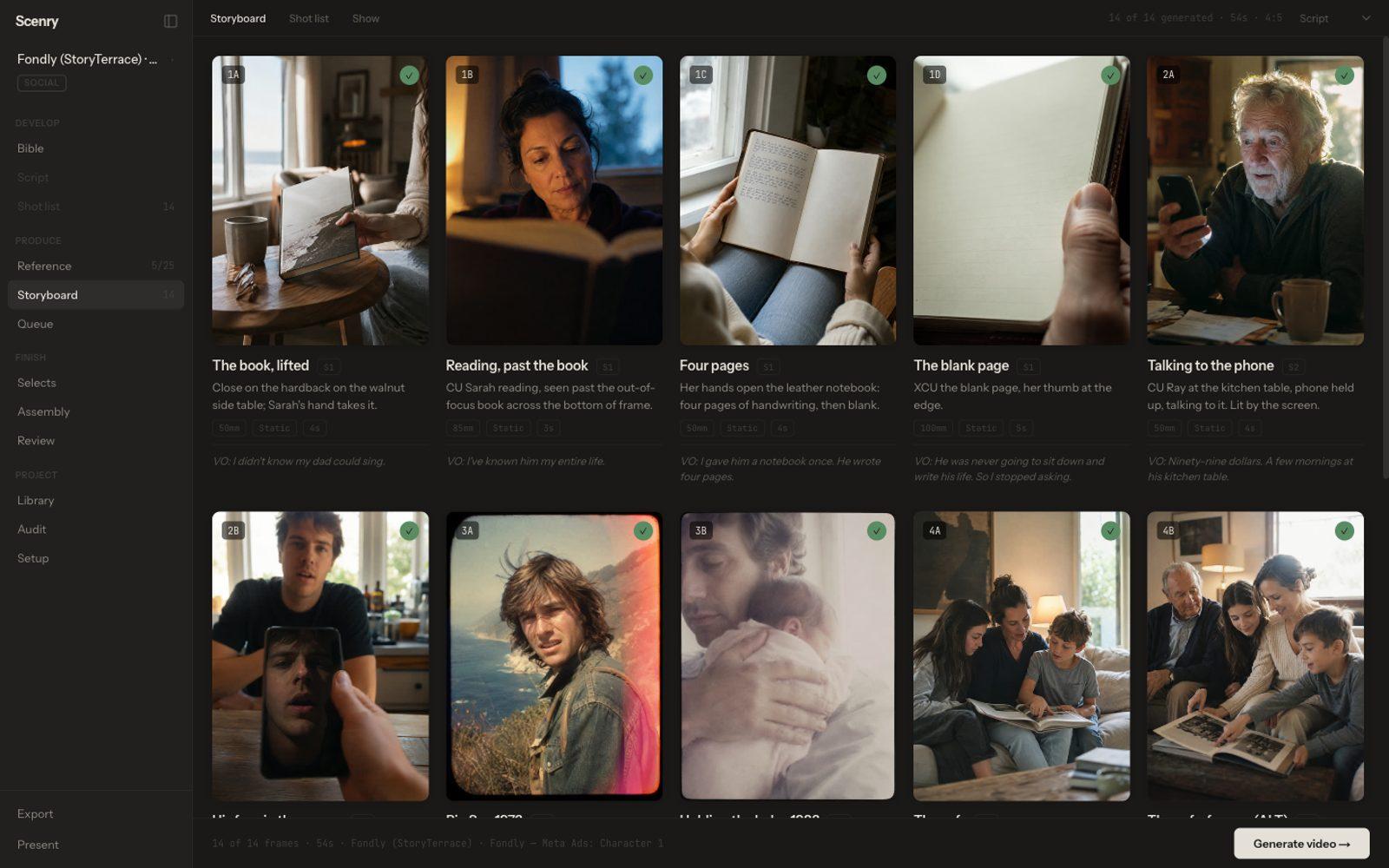
A project moves through the same stages a crew would: characters, locations and props first, then the shot list, a storyboard frame for every shot, motion for each one, then dialogue, sound effects, score and ambience, and finally the assembly. Each stage is a skill I can run on one shot or a whole episode, and the heavy lifting runs in parallel agents.
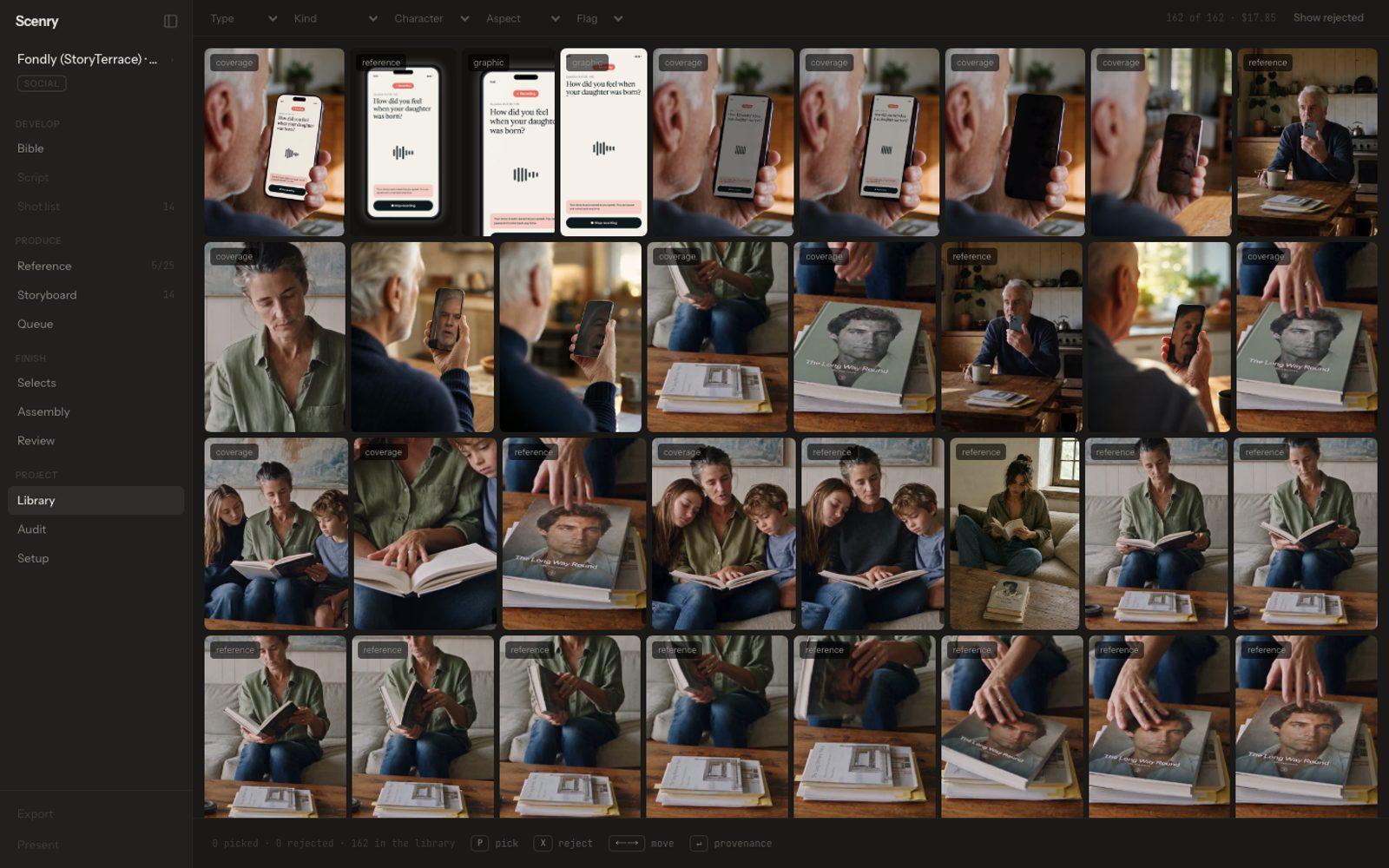
The library: every generation in one place, picked or rejected on a key press, each one traceable to the prompt that made it.
The same face in every shot.
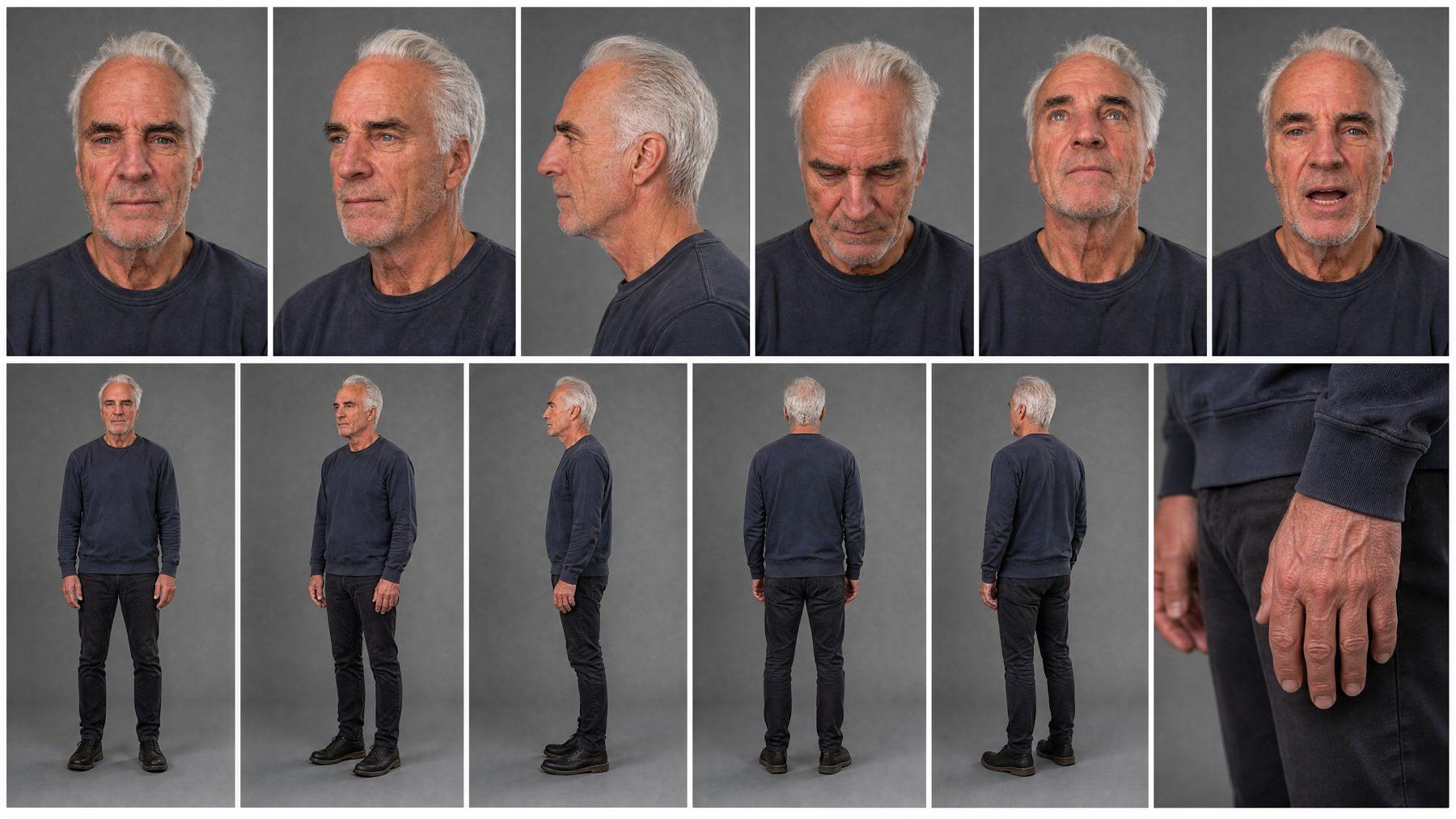
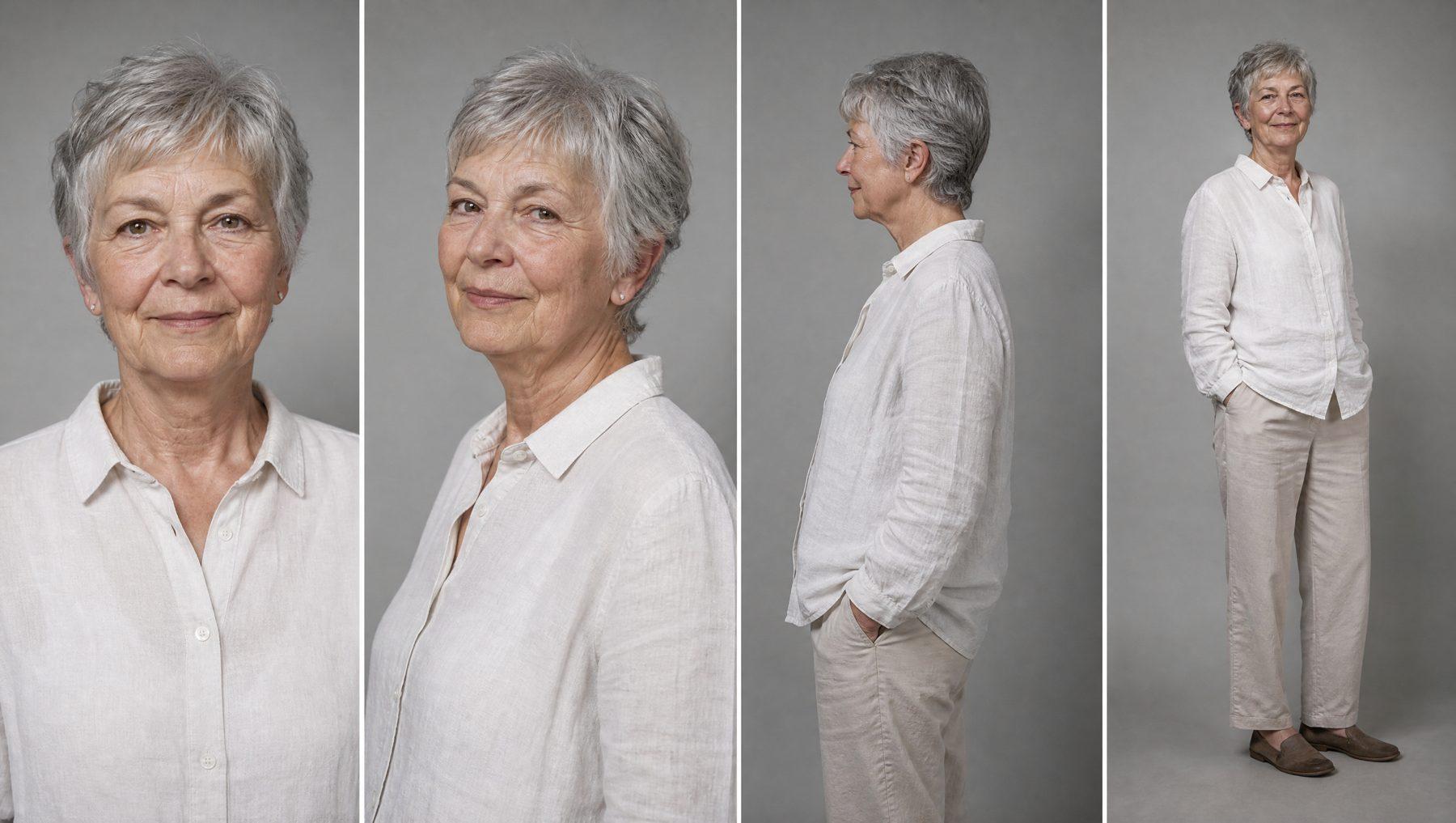
Characters are cast on Midjourney. The picked character sheet then travels with every later generation as a reference image, so consistency does not depend on an ID that sits inside someone else's platform. The same goes for locations, props and wardrobe.
A director's rules, enforced.
Scenry ships with director protocols, a tokenised visual language for a named director, and I can build a new one from five to ten reference frames and a DP credit. Before any generation is sent, an auditor checks the prompt against the protocol's wrong-if list, and it checks the returned frame again afterwards.
Every model gets its own prompt refiner. It reads a guide for that model and builds the prompt the way that model likes it: Seedance for default motion, Kling for choreographed shots with exact cut lengths, Veo for slow narrative moves, GPT Image for visible text and casting.
Finished work, not just frames.
The proof is the work that comes out. For Fondly, a StoryTerrace brand, I ran a set of Meta ads through Scenry: a testimonial, a two-hander with lip-synced dialogue and a lifestyle film, each in 9:16 and 4:5. The research had found that the leading competitors' ads were all talking heads, so these were made as short films.
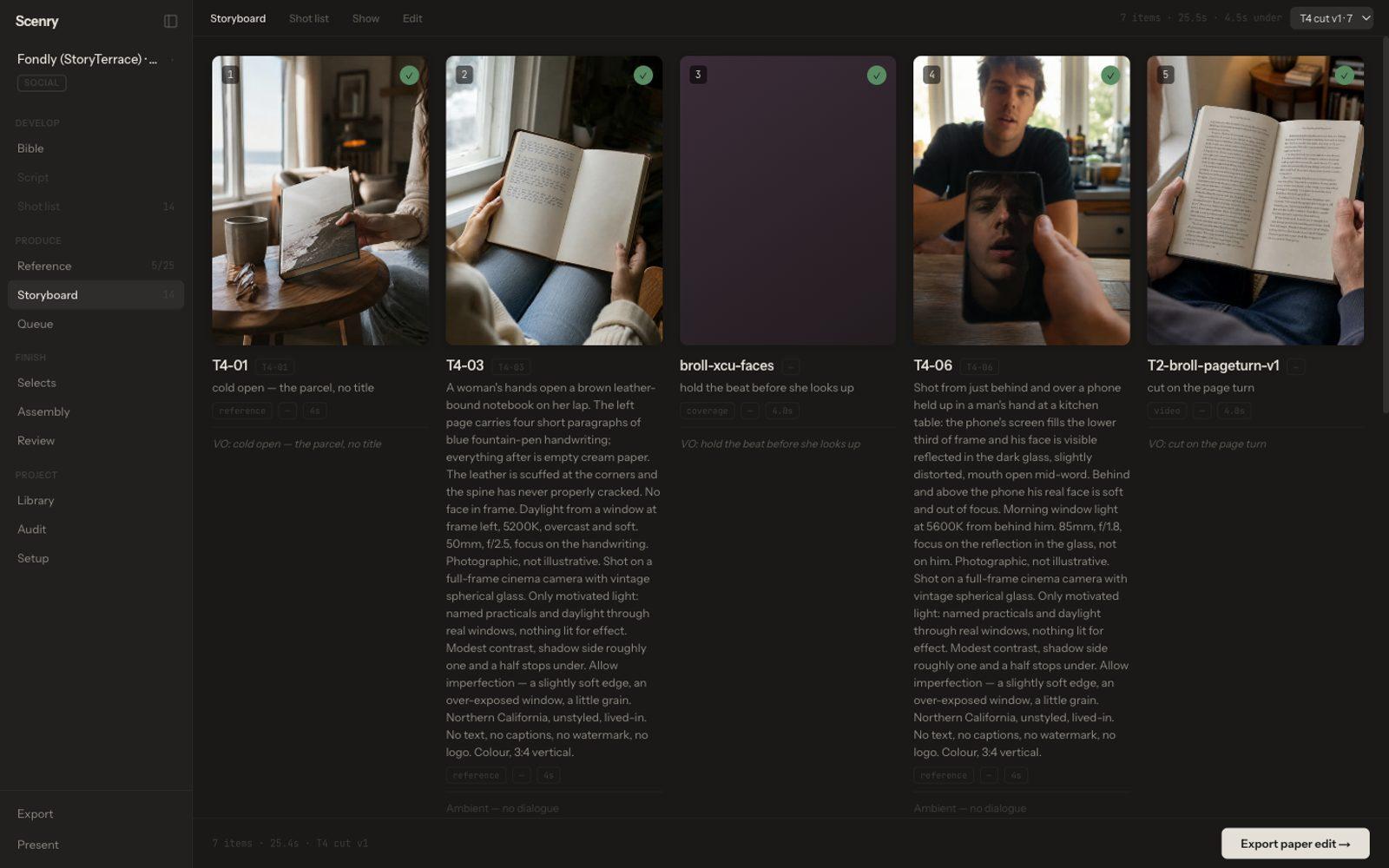
The cut: shots in order, with the voice over line for each, ready to export as a paper edit.
Pro tools at the end of the chain.
The assembly exports an EDL and a multi-track FCPXML, so an editor can open it in their own timeline. A Gemini review gives editorial notes on pacing, performance and continuity, and checks the cut against the director protocol. Every generation is logged with its prompt, cost and time, and an archive step pulls the full resolution files before the providers' links expire.
credits
- What it is
- My own AI production system
- My role
- Creator and product owner
- Built with
- Claude Code
- Stack
- Next.js, Anthropic SDK, Remotion, Claude plugins, MCP
- Work shown
- Fondly (StoryTerrace) Meta ads, through my studio Sibling
Scenry is my own production system. If you want to see it run, book a call and I'll walk you through it.